
This check verifies that every secret and key in your Azure Key Vaults has an end date and is not used after it. It answers the auditor's question: are your secrets and keys rotated, and can you show that you keep checking?
In short: ISOPlanner reads your Azure through a read-only access identity that your cloud administrator creates in your own Azure. A secret or key passes when it has an end date that has not passed; one that ends soon is a warning. When one secret or key fails, the run is rejected and a task is created that says per secret or key what was found and what to do. Every scheduled run is kept as evidence and is linked to the controls named below. The check is one of the four checks of the Microsoft Azure app in the Store, and the four share one connection.
What the check verifies
For every enabled secret and key in the Key Vaults in scope, the check reads the end date. An item without one fails, and so does an expired item that is still enabled. An item that ends within the warning period is a warning and passes. Disabled items are skipped. The run is accepted when no item fails. Only names and dates are read, never values; certificates and Managed HSM are not checked.
| Framework | Controls this check gives evidence for |
|---|---|
| ISO 27001:2022 | A.5.17 Authentication information, A.8.24 Use of cryptography |
| SOC 2 | CC6.1 Logical access security |
| NIS2 Quality Mark (High) | 4.12 Cryptography and Encryption |
When you add the check, ISOPlanner links it to the controls in this table of the frameworks your organization uses, and to the controls of your other frameworks that are related to them. A framework you add later is linked the same way. The NIS2 Quality Mark has three levels (Basic, Substantial and High) and your organization uses one of them; each NIS2 row names the levels it applies to. You can change the links. The check is evidence for these controls; it does not cover them completely.
Before you start
- Automated control monitoring is part of the Business and Premium subscriptions of ISOPlanner.
- The check belongs to the Microsoft Azure app. Add the app first: go to Administration > Store, click More info on the Microsoft Azure tile and then Start free trial. The trial takes 30 days and renews into a paid subscription unless you cancel it. If your organization already uses another Microsoft Azure check, this check is already there.
- You need a licensed manager or administrator role in ISOPlanner to add the app and to set up the check.
- The check works on every Azure subscription with Key Vaults.
- A cloud administrator with Owner on the subscriptions sets up the access from a setup link you send; they need no ISOPlanner account.
- To make a failing item pass, somebody must be able to renew it and set its end date.
The access holds a custom role with read actions only. This check needs:
| Permission | Why |
|---|---|
Microsoft.Resources/subscriptions/read, Microsoft.Resources/subscriptions/resourceGroups/read, Microsoft.Authorization/permissions/read | Lists what the identity can read. Needed by every Azure check. |
Microsoft.KeyVault/vaults/read | Lists the Key Vaults. Also needed by the Key Vaults check. |
Microsoft.KeyVault/vaults/keys/read, Microsoft.KeyVault/vaults/secrets/read | Reads names, state and end dates. Needed by this check only. |
1. Connect Microsoft Azure
You connect once. All four Microsoft Azure checks use the same connection.
- Go to Administration > Settings > Automation, open the tab Control monitoring and click the card Microsoft Azure: secrets and keys do not expire unnoticed.
- Under Authorization click Set up. In the Azure access dialog, under Also ask access for other checks? (optional), keep the Azure checks you may turn on later and click Create setup link.
- Click Copy or Share by email and send the link to your cloud administrator. It is valid for 7 days.
- Your cloud administrator follows the link, creates a managed identity with the read-only role in your Azure and pastes two ids back (Give ISOPlanner read-only access to Azure).
- The access shows Applying for up to 15 minutes, then Connected. You get an email either way.
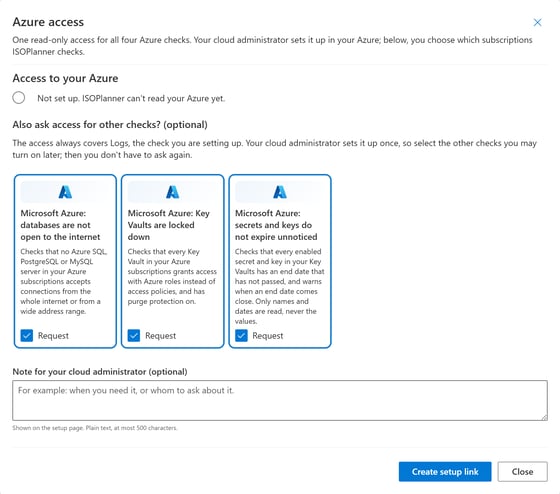
ISOPlanner holds no password, key or secret for your Azure. To change what it reads, click Manage access, then Send a new setup link. To disconnect, your cloud administrator deletes the managed identity.
2. Choose the subscriptions
Subscriptions
Set once for all four Azure checks: Manage access, under What ISOPlanner checks.
| Option | What it does |
|---|---|
| In scope | On by default for every readable subscription, also a new one. Switch it off for one outside your management system and give the Reason for excluding. |
| Resource groups | All resource groups by default. Click it to exclude groups, such as a test environment. |
Click Save scope. A run checks at most 50 subscriptions; at most 200 resource groups can be excluded per subscription. With access limited to some resource groups, a new group is not checked until ISOPlanner gets access.
Options
Click Test under Test and manage results, then Options. A change applies after you save the check.
| Option | What it does |
|---|---|
| Days of warning before the end date | 30 by default, from 1 to 365. An item ending within this number of days is a warning; the check still passes. |
3. Test and read the result
The test starts when you open the dialog; Run starts it again after you change the options. A test shows the result and stores nothing.
| Column | What it shows |
|---|---|
| Secret or key | Its name. |
| Type | Secret or Key. |
| Key Vault | The vault that holds it. |
| Subscription | Its subscription. |
| Expires on | The end date, if any. |
| State | What the check found; point at it for what to do. |
Items that meet the rule are counted under the table; Show all lists them. When no item fails, Run outcome: is Evidence Accepted; one item that fails, for example a secret without an end date, makes it Evidence Rejected.
4. Schedule and switch on
- In the test dialog choose the Incident response template: the task template ISOPlanner uses when a run is rejected. Give the template an assignee.
- Under Set a schedule click Schedule. The check can run daily at most.
- Under Status switch the check to Active.
From then on every run stores Evidence Accepted or Evidence Rejected. A rejected run creates a task from the template with one checklist item per failing secret or key: what was found and where to change it. How the results show in the annual plan, on dashboards and on the controls is in Automated Control Monitoring.
The statuses at a glance
State per secret or key
| Found | Meaning | What to do |
|---|---|---|
| Meets the rule | Ends after the warning period. Passes. | Nothing. |
| Expires soon | Ends within the warning period. A warning. | Renew it in time. |
| No end date | No expiration date. Fails. | Set an end date. |
| Expired | Past its end date and still enabled. Fails. | Renew it, or disable it. |
| Keys not checked | Its vault is closed to the internet. Does not count. | See the questions below. |
| Could not check | The subscription could not be read. Fails. | Restore read access, or exclude it. |
| No longer readable | A resource group read before is gone or unreadable. Fails. | Restore access, or exclude it. |
| Accepted until a date | You accepted the finding until then. | Fix it before the date. |
The outcome of a run and the status of the check
| Status | Meaning |
|---|---|
| Evidence Accepted | No item failed, or there was nothing to check. |
| Evidence Rejected | At least one item failed, or something could not be read (see the questions below). |
| Active | The check runs on its schedule. |
| Needs Attention | The check is switched on but the Microsoft Azure connection is not authorized, for example because the access was revoked. |
| Disabled | The check does not run. This is the status right after you add the app. |
Questions and troubleshooting
The result says "ISOPlanner could not check anything"
Keys show Keys not checked when the vault is closed to the internet, so its keys cannot be read; its secrets are checked. "Allow trusted Microsoft services to bypass this firewall" under Networking lets ISOPlanner read them while the vault stays closed; otherwise check these keys yourself. With nothing else to check, the run is rejected.
A secret or key must stay as it is for a while
Select its row, click Accept until..., choose an end date at most 6 months away, give the reason and save the check. A check holds at most 50 acceptances; each covers only the state it was given for.
The result says "This check needs reads that ISOPlanner's Azure role doesn't have yet"
The access was set up without this check. Click Update access under Authorization and send the new link to your cloud administrator. When only some reads are missing, the panel names the parts, such as "PostgreSQL not checked: no read access", and the check runs on the rest.
The result says "Azure is not connected, so nothing was checked"
No access was set up, or Azure refuses ISOPlanner because the managed identity or its trust was deleted (Access revoked): click Set up again and send the link. With Setup failed the dialog names the reason; the setup article explains each one. When the dialog says access can't be set up on this ISOPlanner environment yet, or names a problem on ISOPlanner's side, nothing in your Azure needs to change.
Test is greyed out
The access is not Connected yet. Finish step 1 first.
The result says "ISOPlanner cannot read any Azure subscription", or a subscription shows Could not check
The role or its assignment is missing or was removed. Have it restored, then click Test connection in the Azure access dialog; or exclude the subscription. Such a row cannot be accepted.
The result says "The scope on the connection can't be used"
More than 50 subscriptions are in scope, or an exclusion has no reason. Correct it and click Save scope.
I cannot delete the check
A check of an app you subscribe to cannot be removed, only switched to Disabled. To stop paying for the Microsoft Azure app, cancel it in the Store. The access stays in Azure until your cloud administrator deletes the managed identity, the role assignment and the custom role.
Related articles
- Automated Control Monitoring: how control monitoring works, the trial and the price, the annual plan and the dashboards
- Give ISOPlanner read-only access to Azure: the setup for your cloud administrator
- Store
- Microsoft Azure: databases are not open to the internet
- Microsoft Azure: Key Vaults are locked down
- Microsoft Azure: logs are kept