
This check verifies that the branches of your GitHub repositories accept changes only through a pull request with the approvals you require. It answers the question an auditor asks: is every code change reviewed before it is merged, and can you show that you keep checking?
In short: ISOPlanner reads the branch protection of your repositories through the ISOPlanner GitHub App, which an owner of your organization installs with read-only permissions. A branch passes when it requires a pull request with at least the number of approvals you set, and the other review settings you ask for. When one repository fails, the run is rejected and a task is created that names per repository what to fix on GitHub. Every scheduled run is kept as evidence and is linked to the controls named below. The check is one of the six checks of the GitHub app in the Store; five of them share one connection.
What the check verifies
For each branch a rule names, the check reads the branch protection rule and the active rulesets; the highest number of approvals counts. A branch passes when it requires a pull request with at least Minimum approvals approvals and, when the rule asks, a code owner review and dismissal of approvals after new commits. The run is accepted when every evaluated repository passes.
| Framework | Controls this check gives evidence for |
|---|---|
| ISO 27001:2022 | A.8.25 Secure development life cycle, A.8.28 Secure coding, A.8.32 Change management |
| SOC 2 | CC8.1 Change management |
| NIS2 Quality Mark (High) | 4.15 Controlled implementation of changes, 6.3 Developing secure software |
| NIS2 Quality Mark (Substantial) | 6.3 Developing secure software |
When you add the check, ISOPlanner links it to the controls in this table of the frameworks your organization uses, and to the controls of your other frameworks that are related to them. A framework you add later is linked the same way. The NIS2 Quality Mark has three levels (Basic, Substantial and High) and your organization uses one of them; each NIS2 row names the levels it applies to. You can change the links. The check is evidence for these controls; it does not cover them completely.
Before you start
- Automated control monitoring is part of the Business and Premium subscriptions of ISOPlanner.
- The check belongs to the GitHub app. Add the app first: go to Administration > Store, click More info on the GitHub tile and then Start free trial. The trial takes 30 days and renews into a paid subscription unless you cancel it. If your organization already uses another GitHub check, this check is already there.
- You need a licensed manager or administrator role in ISOPlanner to add the app and to set up the check.
- An organization on GitHub.com: personal accounts and GitHub Enterprise Server are not supported. Private repositories need a paid GitHub plan (Team or Enterprise): on GitHub Free they have no branch protection and fail.
- An owner of the GitHub organization installs the ISOPlanner GitHub App and connects it in ISOPlanner; anyone else is refused.
- To make a failing repository pass, an administrator of the repository changes its rules on GitHub.
The app asks for these permissions, all read-only, in one set:
| Permission | Why |
|---|---|
| Repository: Administration (read) | Reads the branch protection rules. |
| Repository: Metadata (read) | Lists the granted repositories and reads the active rulesets. |
| Organization: Members (read) | Lists the members and outside collaborators, and confirms that you are an owner when you connect. |
| Organization: Administration (read) | Reads whether the organization requires two-factor authentication. |
1. Connect GitHub
You connect once. Five of the six GitHub checks use the same connection, the ISOPlanner GitHub App; GitHub CODEOWNERS file exists has one of its own.
- Go to Administration > Settings > Automation, open the tab Control monitoring and click the card GitHub pull requests need review.
- Under Authorization click Connect GitHub, then Continue to GitHub.
- Sign in on GitHub as an owner. If the app is not installed yet, choose the organization, all or selected repositories, and approve the read permissions.
- GitHub returns you to ISOPlanner, and the dialog says that it is connected to your GitHub organization.
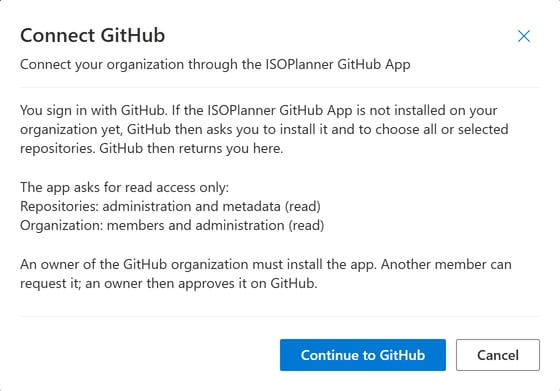
Finish on GitHub within 15 minutes. ISOPlanner stores no password or token, only the installation. To change which repositories the app sees, or to remove it, click Manage on GitHub; Reconnect GitHub connects again.
2. Set the options
Repositories
Click Test under Test and manage results, then Repositories.
| Option | What it does |
|---|---|
| All repositories granted to the app | The default. Every repository the app can see, also one you grant it later. |
| Repositories to leave out | With all repositories: names not checked, one per line, at most 100. |
| Only the repositories named below | Only the names under Repository names, 1 to 100. |
| Include archived repositories | Off by default. |
| Include forks | Off by default. |
Options
Click Options. The default branch rules hold for every repository without rules of its own; Add branch rule adds one, at most 10.
| Option | What it does |
|---|---|
| Branch | Empty by default: the default branch of each repository. Or the name of a branch. |
| Minimum approvals | 1 by default, from 1 to 6. CIS recommends two. |
| An owner of the changed code must approve | Off by default. |
| New commits dismiss earlier approvals | Off by default. |
| A checklist item per repository | On by default. Off: one checklist item lists the repositories that do not comply. |
For rules of their own, select repositories in the result and click Repository settings (at most 200 repositories); Use default rules undoes it. A rule names a branch, not a pattern such as release/*. A run evaluates at most 200 repositories and reads at most 1,500 branches.
3. Test and read the result
The test starts when you open the dialog; Run starts it again after you change the repositories or the rules. A test shows the result and stores nothing.
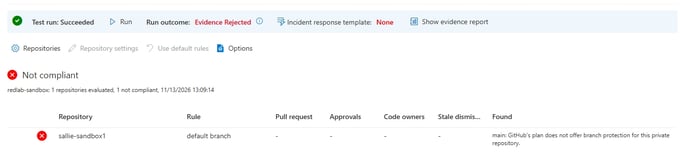
| Column | What it shows |
|---|---|
| Repository | The repository; (own rules) when it has rules of its own. |
| Rule | The branch: default branch, or its name. |
| Pull request | Yes or No. |
| Approvals | Required by the branch / required by the rule, for example 1 / 2. |
| Code owners | Yes, No, or Not required when the rule does not ask for it. |
| Stale dismissed | The same, for dismissing approvals. |
| Found | What the branch requires, or why the rule fails. |
Above the table the result reads Compliant or Not compliant, with the number of repositories evaluated and failing. An icon marks each row that passes or fails.
In this example the only repository is private on GitHub Free, so a pull request cannot be required: Evidence Rejected.
4. Schedule and switch on
- In the test dialog choose the Incident response template: the task template ISOPlanner uses when a run is rejected. Give the template an assignee.
- Under Set a schedule click Schedule. The check can run daily at most.
- Under Status switch the check to Active.
From then on every run stores Evidence Accepted or Evidence Rejected. A rejected run creates a task from the template with one checklist item per failing repository: what was found and where to change it. How the results show in the annual plan, on dashboards and on the controls is in Automated Control Monitoring.
The statuses at a glance
Review rules per branch
| Found | Meaning | What to do |
|---|---|---|
| Pull request required; approvals: ... | It passes. | Nothing. |
| Changes can be pushed directly | It fails. | Require a pull request in a ruleset or branch protection rule. |
| The branch requires 1 approvals, at least 2 are needed. | It fails. | Raise Required approvals. |
| Review by code owners is not required | Only when the rule asks for it. It fails. | Enable "Require review from Code Owners". |
| Approvals stay valid after new commits | Only when the rule asks for it. It fails. | Enable "Dismiss stale pull request approvals when new commits are pushed". |
| GitHub's plan does not offer branch protection for this private repository. | Private, on GitHub Free. It fails. | Move to a paid plan, or leave the repository out and record why. |
| The branch does not exist. | It fails. | Correct the branch name of the rule. |
| The repository does not exist or is not granted to the ISOPlanner GitHub App. | It fails. | Grant it to the app on GitHub, or correct the selection. |
The outcome of a run and the status of the check
| Status | Meaning |
|---|---|
| Evidence Accepted | Every evaluated repository passed. |
| Evidence Rejected | At least one repository failed, no repository was left to evaluate, or not every repository could be read. |
| Active | The check runs on its schedule. |
| Needs Attention | The check is switched on but the GitHub connection is not authorized, for example because the app was removed or suspended, or a new permission was not accepted. |
| Disabled | The check does not run. This is the status right after you add the app. |
Questions and troubleshooting
The branch requires pull requests, but the check still fails
Look at Found: the branch requires fewer approvals, or no code owner review or dismissal, than the rule asks.
The minimum approvals must be a number from 1 to 6.
Enter a whole number from 1 to 6.
Only an owner of the GitHub organization can connect it to ISOPlanner.
A member can only request the installation. An owner approves it on GitHub and clicks Connect GitHub.
The app was installed on a personal GitHub account.
Install it on your organization instead.
This GitHub installation could not be matched to your request.
The steps on GitHub took over 15 minutes or were started by someone else. Click Connect GitHub again.
The app is no longer installed, is suspended, or asks for a permission that was not accepted
The check shows Needs Attention. An owner fixes it on GitHub (Open on GitHub in the dialog), then tests the connection again.
No repository to evaluate
None of the repositories granted to the app fits the selection. Grant repositories on GitHub or widen the selection.
Not every repository was evaluated
The selection holds more repositories or branches than one run reads, so every run is rejected. Narrow the selection.
I cannot delete the check
A check of an app you subscribe to cannot be removed, only switched to Disabled. To stop paying for the GitHub app, cancel it in the Store. The ISOPlanner GitHub App stays installed until an owner uninstalls it on GitHub (organization Settings > GitHub Apps).
Related articles
- Automated Control Monitoring: how control monitoring works, the trial and the price, the annual plan and the dashboards
- Store
- GitHub branch protection is enforced
- GitHub two-factor authentication is enforced
- GitHub version control is used
- GitHub force pushes are blocked
- GitHub CODEOWNERS file exists